
Scripts
Write the first line of your reel last
How to find a hook for your reel: why you should not write the first line in advance, where it hides and how to test it in five seconds.
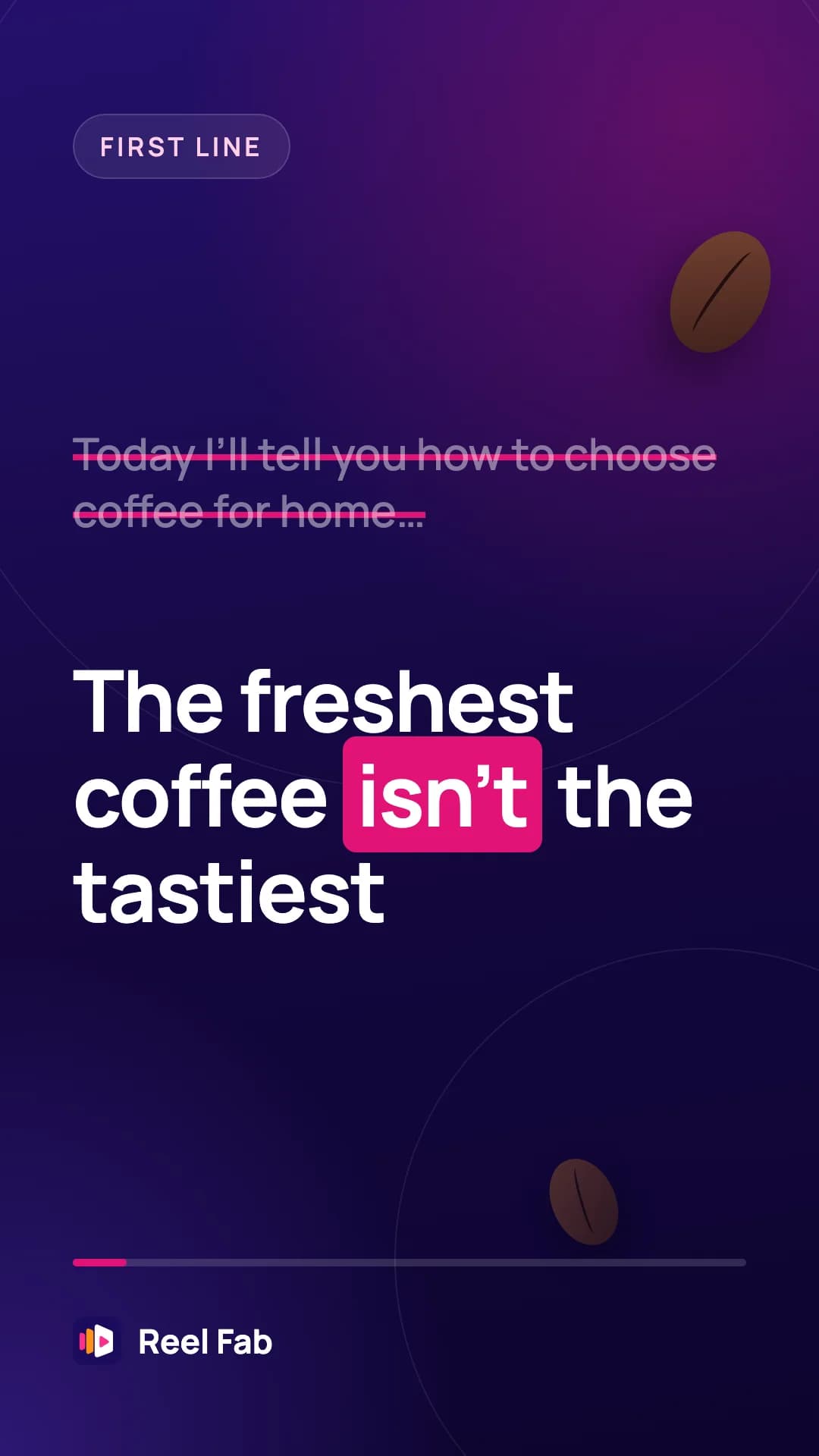
You've spent twenty minutes rewriting the first line. Below it, your note holds nothing but the topic: "How to choose coffee for home." The words keep trading places, and the line isn't getting any better.
It won't. You're trying to write the strongest sentence of the reel before you know what's in it.
Why you can't invent an opening
The first line — the hook — has one job: stop the thumb. People decide in a second or two, and not with their heads. If the line doesn't catch on anything, they keep scrolling. Even if ten seconds later you have the most useful thing they'll hear all week.
When you write the opening first, there's nothing for it to catch on. The idea isn't formed yet, and you have no examples. So your hand writes on autopilot: "Today I'll tell you how to choose coffee." That's not an opening, it's an announcement. And "an announcement signals that what follows will take a while, and people leave before the substance"1.
So leave the first line blank. Talk it out first.
Talk it out, then look in the middle
Turn on a voice recorder or the camera and explain the topic as if to a friend in your kitchen. Don't stop, and don't pick your words. Then listen back or read the transcript.
It usually sounds something like this:
So, how to choose coffee for home. Well, check the roast date, that matters. Everyone wants it as fresh as possible, and that's fair, but. I used to buy a bag straight from the roastery on roast day and brew it that evening. And it was sour. I thought the beans were bad. But they just hadn't rested: after roasting, beans keep releasing carbon dioxide for several days, and it gets in the way of a proper brew. Now I wait three or four days for filter, and a week, sometimes two, for espresso.
The first three sentences are a warm-up. You can cut them entirely. The opening hides where you say "but" and what follows is something not everyone will agree with:
The freshest coffee isn't the tastiest.
That's your first line. It argues with what the viewer takes for granted: fresher means better. And you have everything you need to defend it: the gas, the sour taste, the exact number of days.
It works this way almost every time. You say the sharpest thing not at the start, but once you finally stop warming up — right after "so," "actually," "I used to think."
Test your hook in five seconds
Read the idea out loud and notice the reaction it gets. "If the reaction is 'yeah, so what?', that's not controversy, it's a statement of fact. If it's 'wait, that's debatable' or 'I disagree', the idea is worth working on"2.
Let's run our options through it.
"Today we'll talk about coffee freshness." No reaction. Doesn't work.
"The roast date matters." Yeah, so what? Nobody argues with that, so there's no reason to keep listening.
"The freshest coffee isn't the tastiest." Wait, what? There it is. A small hole has opened in a familiar picture, and the viewer stays to close it. Now they have a choice: "agree and hear the arguments, or disagree and find where you're wrong. Both reactions keep people watching"3.
Three ways to ruin a good opening
Explaining right away. "Coffee needs to rest for a week after roasting. Here's why." The answer is already out, so there's nothing left to wait for. "The loop closes before it opens"4. Save the conclusion for the end.
Hedging. "Maybe I'm wrong, but I think…" A disclaimer like that "takes the edge off and devalues everything that follows"5. If you doubt the idea, test it before you film, not by apologizing on camera.
Overpromising. "The biggest mistake every coffee lover makes." You talk about one detail but promise everything. By the middle the viewer notices and leaves feeling played. Sharp, yes. Empty, no.
The last line closes the first
Once you've found the opening, look at the ending. A strong ending brings the viewer back to where you started, only now they know more:
So don't open a fresh bag right away. Let it sit. The taste is worth it.
And no "hope this was helpful" or "thanks for watching." That's "politeness in place of your strongest line"6.
If the reel is already filmed and the opening came out flat, don't reshoot everything. Find the strong line in the recording — in the Reel Fab editor that's easy to do with the speech transcript — and record it as a separate short take. For putting a whole reel together, see our guide to your first reel.
And next time you get stuck on the first line, just skip it. It's already in what you want to say. For now, somewhere in the middle.